Last updated on September 28th, 2026 at 08:45 pm
Every sport has a language, and paintball’s is thick enough that a first-timer can lose the thread of a staging-area conversation in under a minute. This glossary collects the terms that actually come up, organized by category. A few of them, like FPS, wiping, and the bunker names, matter enough that we have written full guides on them, linked where they appear.
Equipment Terms
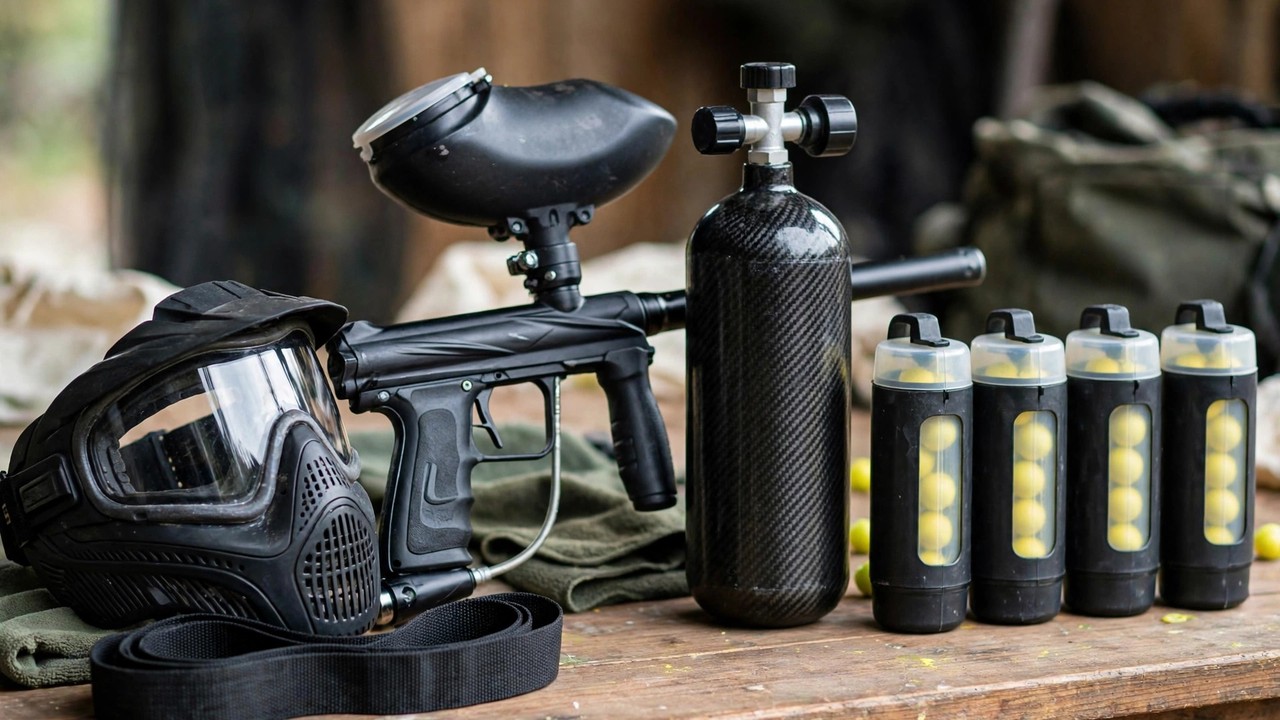
The hardware vocabulary is the first layer you will hear, and most of it maps onto the handful of items every player carries. The mechanics behind the first two entries are covered in our guides to how paintball guns work and how hoppers work.
- Marker: the paintball gun. The sport’s original and official term, dating from the tool’s roots in forestry and cattle marking.
- Hopper or Loader: the container that feeds paint into the marker, either by gravity or by a motorized force-feed system.
- Pod: a plastic tube of spare paint, typically around 140 rounds, carried in a harness and dumped into the hopper mid-game.
- Harness or Pack: the belt rig that holds pods, worn on the lower back.
- HPA: high pressure air, the compressed air system that powers most modern markers, stored at 3,000 to 4,500 psi. CO2 is the older liquid gas alternative.
- Regulator: the valve assembly that steps tank pressure down to what the marker needs.
- Hydro Date: the stamped date showing a tank’s last hydrostatic requalification. An expired date means no fill, anywhere.
- Chronograph or Chrono: the radar device that measures muzzle velocity before and during play. Also used as a verb: chrono in before the game.
- Barrel Cover or Barrel Sock: the fabric cover that goes over the muzzle whenever a player is off the field, so an accidental shot goes nowhere.
- Squeegee or Swab: the barrel cleaning tool for clearing a broken ball mid-game.
- Goggle System: the mask. Always a full paintball-rated system covering eyes, ears, and face, never shop glasses.
Tanks come with their own paperwork trail: the hydro date above is explained in our guide to hydro testing, and it is also the reason a tank’s regulator has to come off entirely when you are flying with a paintball gun.
Gameplay Terms
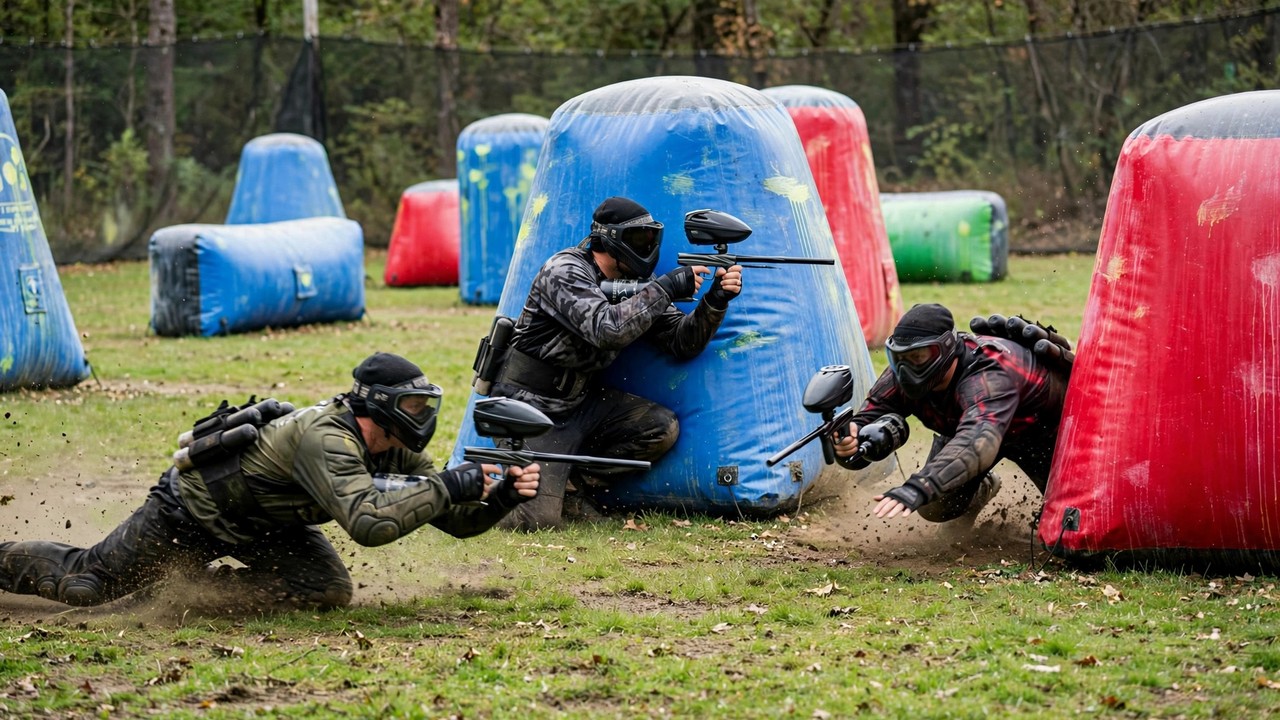
These are the words that decide who is in and who is out. The first three form the backbone of the rules of paintball, and the difference between a bounce and a hit settles more arguments than any other line in the rulebook, which is why what is a bounce gets its own guide.
- Hit: a paintball that breaks on a player or their gear and leaves a solid mark. The definition the whole game runs on.
- Bounce: a ball that hits but does not break. Not an elimination.
- Splatter: spray from a ball that broke on something nearby. Looks incriminating, counts for nothing.
- Paint Check: asking a referee to inspect a player for a valid hit, often called mid-point.
- Wiping: removing a hit to keep playing. The sport’s cardinal sin, penalized harder than anything else.
- Playing On: continuing after a valid hit, deliberately or not. Draws its own penalty in tournament play.
- Overshooting or Bonus Balling: continuing to shoot an obviously eliminated player. Legal gray zone, etiquette violation everywhere.
- Breakout: the opening seconds of a point, when both teams sprint from their start stations to their first bunkers.
- Laning: shooting a fixed stream of paint through a gap opponents must cross during the breakout.
- Snap Shooting: the pop-out, shoot, drop-back gunfighting technique from behind a bunker edge.
- Bunkering: sprinting to an opponent’s bunker and eliminating them at point-blank range.
- Bumping: moving up the field bunker to bunker while a teammate covers.
- Walking the Trigger: alternating two fingers on the trigger for high sustained rates of fire.
- Callouts: the coded position reports teammates exchange mid-game, built on bunker names.
The tactical entries in that list, from the breakout through callouts, each have a dedicated guide in our tactics and technique hub, which is the better place to learn them than any definition.
Field and Position Terms
Tournament fields are built from named inflatable shapes, and the names double as the team’s coordinate system. The full tour of the shapes lives in paintball bunkers explained, and how the roles map onto them is covered in paintball positions.
- Bunker: any cover piece on the field, from inflatable snakes and doritos to woodsball plywood forts.
- Snake Side and Dorito Side: the two halves of a tournament field, named for the signature bunker chain on each sideline.
- Tape or Tapeline: the field boundary lines; playing the tape means advancing along the edge.
- Home or Back Center: the large starting bunker at each end of the field.
- The Fifty: the midfield line, halfway up the field. Reaching the fifty means you are in the other team’s half of the fight.
- Deadbox: the netted area where eliminated players wait out the point.
- Front, Mid, and Back Players: the three broad roles on a team, from aggressive snake and dorito runners to the back players who anchor and communicate.
Formats and Game Types

Paintball is really a family of games sharing equipment and rules. The full map, with what each format feels like to play, is our pillar on the types of paintball; the entries below are the shorthand versions.
- Speedball: the fast, symmetric, inflatable-bunker format used in tournaments.
- Woodsball: paintball in natural terrain, the sport’s original form.
- Rec Ball: casual walk-on play at a commercial field.
- Scenario: long-format themed games with objectives, respawns, and storylines.
- Milsim and Magfed: military simulation play and the magazine-fed markers it favors.
- Low Impact: the .50 caliber, reduced-energy version of the game for kids and first-timers.
- Game Modes: elimination, capture the flag, attack and defend, and the other objective sets played within any format.
Rules and Numbers
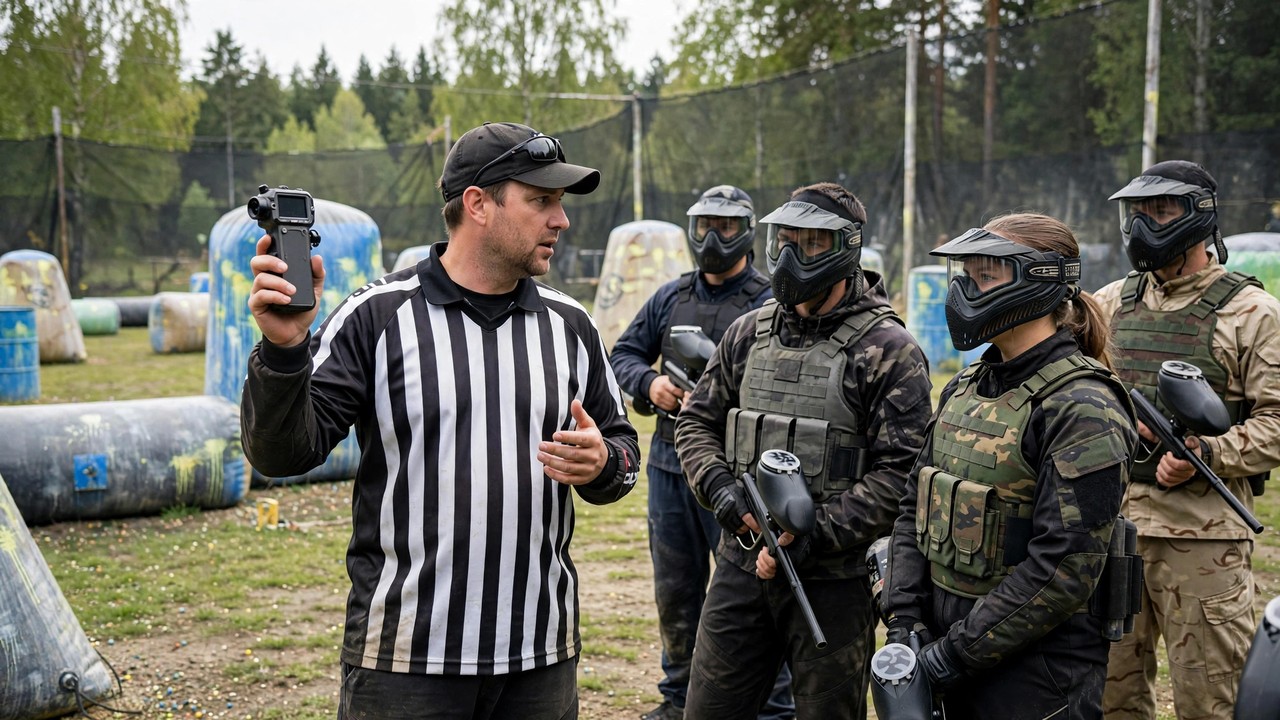
Two numbers govern every marker on every field: velocity, capped at 300 feet per second, and rate of fire, capped at 10.5 balls per second in tournament play through the ramping firing mode.
- FPS: feet per second, muzzle velocity. Fields chrono markers at 280 to 300.
- BPS: balls per second, the rate of fire measure.
- Ramping: the electronic firing mode that adds shots during sustained fast trigger pulling, up to the cap.
- One-for-One, Two-for-One, Three-for-One: the tournament penalty ladder, pulling the offender plus one, two, or three teammates for minor, major, and gross major infractions.
- Walk-On: a player who shows up to open play without a group and joins pickup games; also the name for that style of field day.
Slang You Will Hear in the Staging Area
- Agg: stylish, impressive, cool. A player’s gear or moves can be agg.
- Gogged: shot in the mask, usually announced with delight by whoever fired.
- Lit Up: hit with many balls at once.
- Ghillie: the leafy camouflage suit worn by woodsball snipers.
- Pump: playing with a pump-action marker, one deliberate shot at a time, the sport’s hard mode.
- Stock Class: pump play’s strictest form, with limited paint and 12 gram CO2 cartridges.
- Rental Hero: the walk-on with rented gear who outplays people with tournament setups. Every field has one, and being one is a compliment.
How to Actually Learn the Language

Nobody memorizes a glossary, and nobody needs to. The vocabulary sticks in about two field days because every term names something you will see happen in front of you. If you are new, start with the safety and rules words, hit, bounce, chrono, barrel cover, deadbox, because those are the ones referees expect you to know from minute one. Our guide to paintball for beginners puts all of them in context, and the tactical terms will follow the first time someone yells them at you with paint in the air.
Frequently Asked Questions
A marker. The term predates the sport itself: the tools were built to mark trees and cattle from a distance, and the name stuck when players picked them up.
Stylish or impressive. It is staging-area slang, trimmed down from aggressive, and applies to gear, moves, or a whole kit.
A plastic tube holding roughly 140 spare paintballs, carried in a back harness and emptied into the hopper when it runs low.
To fire your marker over the field chronograph before playing so a referee can confirm it shoots at or under the velocity limit.
The netted area beside the field where eliminated players wait until the point ends.