Last updated on August 28th, 2026 at 06:42 pm
A paintball gun works by using a burst of compressed gas to launch a paintball out of the barrel. Pull the trigger and the marker releases a controlled shot of CO2 or high-pressure air from its tank behind the ball, propelling it toward the target while a bolt loads the next round from the hopper. There are two main types, mechanical and electronic, and they do the same job in different ways.
- Power source: a CO2 or HPA air tank, not an onboard compressor.
- The shot: the trigger releases a metered burst of gas behind the ball.
- The reload: a bolt chambers the next paintball from the hopper.
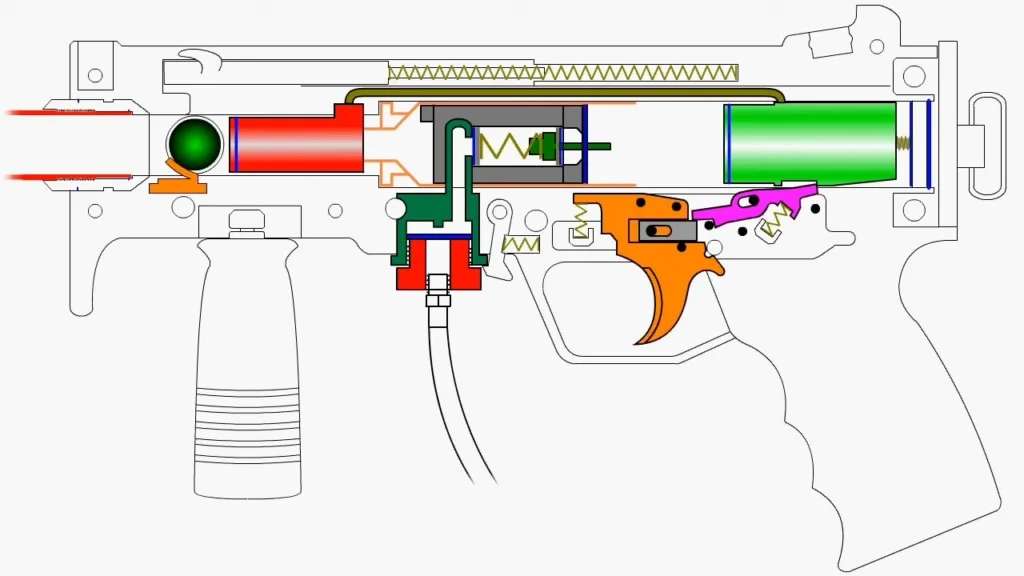
The Basic Principle
Every paintball marker stores energy as compressed gas in an attached tank, either CO2 or high-pressure air (HPA). Firing happens in one quick sequence: the trigger opens a valve, a measured burst of gas is released into the chamber behind the loaded paintball, and that pressure pushes the ball down the barrel at up to around 300 feet per second. At the same time, the bolt moves to seal the chamber and let the next ball drop in, ready for the following shot. There’s no explosion and no onboard compressor, just stored gas being released a shot at a time.
The Key Parts Involved
- Air tank, supplies the CO2 or HPA that does the work.
- Valve, releases a controlled burst of gas per shot.
- Bolt, chambers each ball and seals the gas behind it.
- Hammer or solenoid, trips the valve when you fire.
- Barrel, guides the ball as it accelerates.
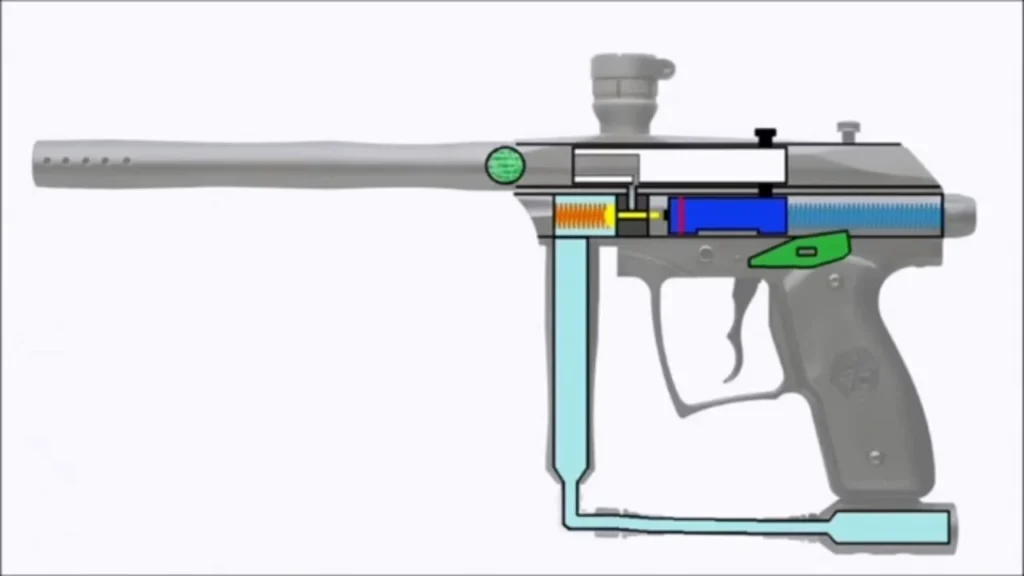
How Mechanical Markers Work
A mechanical marker works with a spring-loaded hammer and no electronics. Pulling the trigger releases a sear, which lets the spring drive the hammer forward to strike the valve and release the gas burst that fires the ball. In the common “blowback” design, some of that gas is used to push the bolt and hammer back and re-cock the marker for the next shot. It’s simple, tough, and reliable, which is why mechanical markers are favourites for beginners and woodsball.
How Electronic Markers Work
An electronic (electropneumatic) marker replaces the mechanical sear with a circuit board and a solenoid. The trigger is just an electronic switch: pull it and the board tells the solenoid to fire the pneumatic valve. Because a computer controls the timing, these markers have very light triggers, high and consistent rates of fire, and programmable modes like semi-auto and ramping. They’re lighter on air and the standard choice for speedball and tournaments.
What Happens Inside the Marker When You Fire
It’s worth seeing the full firing cycle as one quick sequence. When you pull the trigger, the sear or solenoid releases stored energy that opens the valve; a measured burst of compressed gas rushes into the chamber behind the loaded paintball and drives it down the barrel. In the same instant, the bolt cycles, sealing the breech during firing, then moving back so the next ball can drop in from the hopper, and the marker re-cocks, ready to repeat. The whole cycle happens in a fraction of a second, dozens of times a minute.
Blowback and Spool Valve Designs
Within that basic principle, markers use different internal designs. The classic blowback design uses part of the firing gas to push the bolt and hammer back and re-cock the marker, simple, cheap, and common in mechanical markers. Higher-end markers often use a spool valve or poppet system driven by a solenoid, which cycles more smoothly and efficiently for a softer shot and better air economy. The design affects how a marker feels and how much air it uses, but the core job, releasing gas to launch a ball, is identical.
Why Maintenance Keeps It Working
Because a marker relies on seals and precise timing, a little upkeep keeps it firing consistently. Worn o-rings and cup seals cause leaks and velocity swings, dirty internals slow the action, and dry seals wear out faster. Cleaning and lightly lubricating your marker regularly, and replacing seals before they fail, is what keeps the firing cycle crisp and reliable game after game.
Pump Markers: The Simplest Mechanism
Worth a mention alongside mechanical and electronic markers is the pump marker, the most basic firing action of all. Instead of self-recocking, a pump marker is manually re-cocked with a pump handle before every single shot, much like a pump-action shotgun. That makes each shot deliberate and forces careful aim, which is exactly why a dedicated community loves them. The internal principle is identical, a burst of gas launches the ball, but the manual cocking step is done by you rather than by the gas or a solenoid, making pump the purest test of marksmanship in the sport.
The Role of the Regulator
One part quietly shapes how well any marker shoots: the regulator. It takes the high, variable pressure from your tank and delivers a steady, lower pressure to the firing system, shot after shot. That consistency is what keeps your velocity stable, and stable velocity is the foundation of accuracy. A good regulator is a big part of why higher-end markers feel smoother and group better than cheap ones.
Open-Bolt vs Closed-Bolt Designs
Markers also differ in bolt timing. The vast majority are open-bolt, meaning the bolt sits back with the breech open between shots, simple and reliable. A smaller number are closed-bolt, where the bolt rests forward holding a ball ready; these tend to be quieter and can be a touch more accurate on the first shot, but they’re more complex and less common. For most players, open-bolt is the norm and works perfectly well.
How Electronic Boards Add Features
On electronic markers, the circuit board does far more than just fire the solenoid. It provides selectable fire modes like semi-auto and ramping, and it powers “eyes”, small sensors in the breech that detect whether a ball is fully loaded and prevent the bolt from chopping it. Boards can also fine-tune settings like dwell and rate-of-fire caps, letting a player dial the marker in for their paint and their league’s rules.
Why Consistent Air Matters so Much
Everything about how a marker works comes back to delivering the same push behind every ball. If the pressure or timing varies from shot to shot, velocity wanders and accuracy falls apart. That’s why regulators, anti-chop eyes, and clean, well-sealed internals matter more than raw power, a marker that fires consistently will always out-shoot one that’s merely powerful but erratic.
Conclusion
However fancy the marker, the core idea is the same: pull the trigger, release a burst of stored compressed gas, and that gas launches the paintball while the bolt loads the next one. Mechanical markers do it with a spring and hammer; electronic ones do it with a board and solenoid. Understand that sequence and you understand how every paintball gun works.
FAQs
Pulling the trigger opens a valve that releases a measured burst of compressed CO2 or HPA behind the loaded paintball. That pressure pushes the ball down the barrel at up to about 300 FPS, while the bolt chambers the next ball from the hopper.
Compressed gas stored in an attached tank, either CO2 or high-pressure air (HPA). The marker releases a small burst of that stored gas for each shot. There is no onboard compressor; the tank supplies all the energy.
A mechanical marker uses a spring-driven hammer to trip the valve, so it’s simple and rugged. An electronic marker uses a circuit board and solenoid, giving a lighter trigger, higher rate of fire, and programmable modes like ramping.