Last updated on August 28th, 2026 at 06:44 pm
A paintball gun can reach a maximum of about 150 feet, but it’s only reliably accurate to around 80–100 feet. Fields cap marker velocity at roughly 280–300 feet per second for safety, and that limit is what sets the range. Beyond about 100 feet a paintball slows, drops, and gets unpredictable, so “how far it shoots” and “how far it shoots accurately” are two different numbers.
- Maximum range: ~150 feet.
- Effective (accurate) range: ~80–100 feet.
- Velocity cap: ~280–300 FPS, enforced for safety.
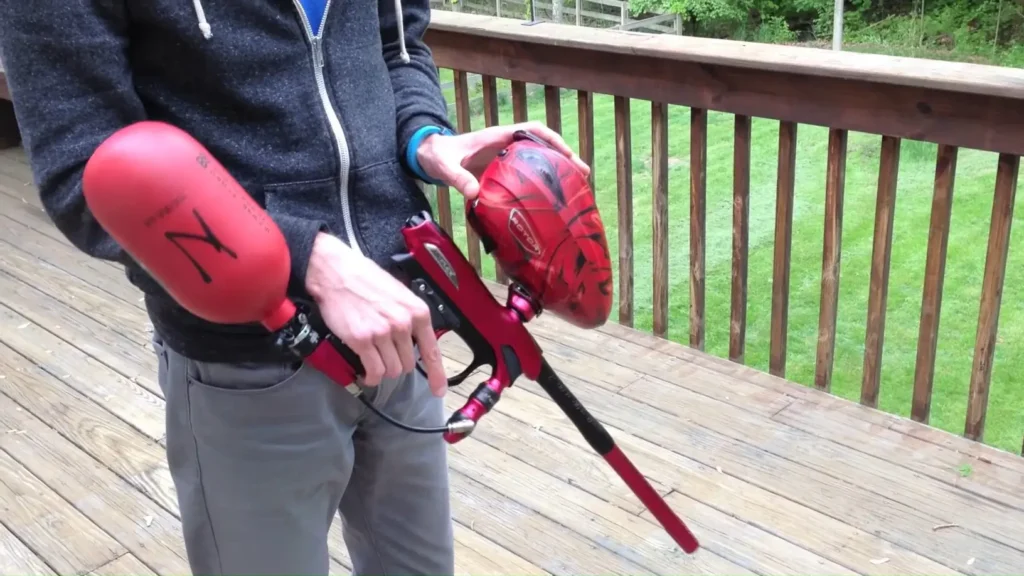
Maximum Range vs. Effective Range
Almost any paintball marker can send a ball out to roughly 150 feet, but hitting a target at that distance is largely luck. The effective range, where you can actually aim and reliably hit, is more like 80 to 100 feet. Past that, the ball has slowed enough that it drops noticeably and any imperfection sends it off course. Knowing that gap is what stops beginners wasting paint firing at opponents they’ll never reach.
Why Velocity Is Capped
Range is deliberately limited by the velocity cap every reputable field enforces, usually 280–300 FPS, checked with a chronograph. Shooting faster than that isn’t just against the rules, it makes hits dangerous. So while a marker could physically be tuned to shoot farther, the cap keeps everyone’s effective range within a safe, consistent window.
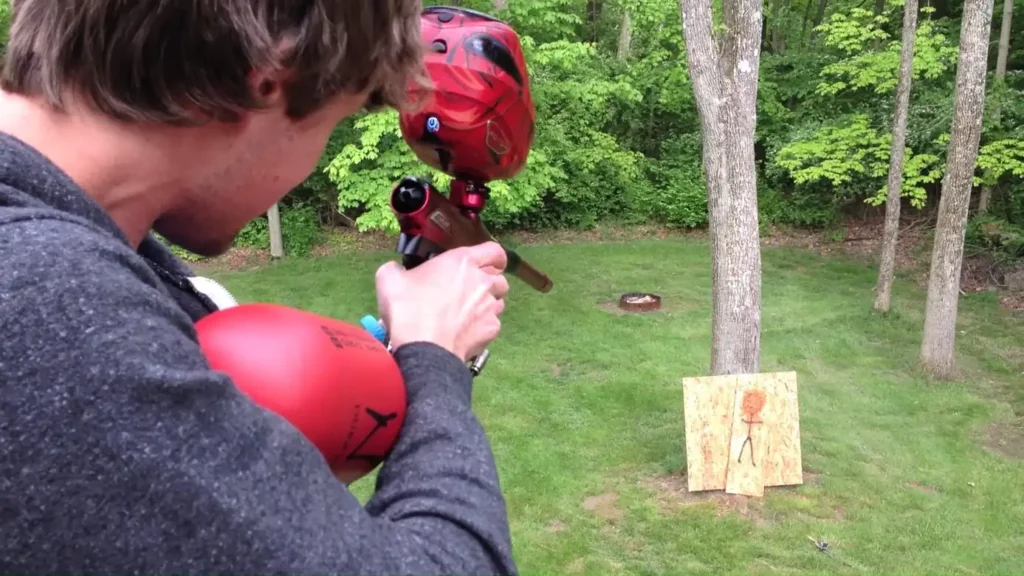
What Affects How Far a Paintball Travels
- Velocity, capped at ~280–300 FPS, the main factor in range.
- Paint quality, fresh, round paint flies straighter and farther than old, out-of-round paint.
- Barrel, a clean barrel with a good paint-to-bore match improves consistency.
- Wind and elevation, a headwind cuts range; aiming slightly high adds distance by using the ball’s arc.
One thing that does not apply to paintball is backspin. Unlike airsoft BBs, paintballs aren’t spin-stabilised, there’s no hop-up on a paintball marker, so their range comes down to velocity and paint quality, not spin.
How to Get the Most Range
To squeeze out every foot of usable range, shoot fresh, round paint, keep your barrel clean and matched to your paint, and make sure your velocity is set right at the field limit with a consistent regulator. Then aim slightly high at distance to let the ball drop onto your target. Those basics do far more for your reach than any single piece of gear.
Why Paintball Velocity Is Capped at 280 FPS
The reason range is limited comes down to safety. Most fields cap markers at 280 feet per second, sometimes up to 300, that’s roughly 190–204 miles per hour. The limit isn’t arbitrary: testing back in the 1980s identified velocities above 300 FPS as the point where a standard paintball can break skin or, through a damaged lens, cause eye injury. Staying at or below the cap keeps hits safe while still ensuring the ball breaks reliably on the target, which is why every reputable field chronographs markers before you play.
How Velocity, Range, and Safety Connect
The same velocity that limits your range is exactly what keeps the game safe to play. At the cap, a paintball reaches an 80–100 foot target in about a third of a second, then slows and drops the further it goes. Tuning a marker to shoot “hotter” for more distance is both dangerous and against the rules everywhere, it turns a sting into a genuine injury risk. So rather than chasing raw range, the goal is to get every ball flying consistently within that safe window, which is what actually wins you hits.
First Strike Rounds: The Long-Range Exception
There is one exception to paintball’s usual range limits. Standard paintballs are smooth, spinless spheres, but First Strike rounds are fin-stabilised, egg-shaped projectiles that fly far straighter and reach noticeably greater distances with real accuracy. They’re popular in magfed and MilSim play for exactly that reason. The trade-offs are cost, they’re much more expensive than round paint, and the need for a compatible barrel or marker, so they remain a specialist choice rather than the norm.
Getting the Most Out of Your Range
To reach the far edge of your effective range, the fundamentals matter more than any gadget: shoot fresh, round paint, keep your barrel clean and matched to that paint, and hold a steady velocity right at the field limit with a good regulator. Then aim slightly high at distance so the ball’s natural arc drops it onto the target. Dial those in and you’ll consistently hit at 80–100 feet, see our guide on making your marker more accurate.
How Weather Affects Your Range
Conditions on the day change how far your paint carries. A tailwind extends your reach while a headwind shortens it and pushes shots off line, so you’ll adjust your aim accordingly. Temperature matters too, especially with CO2, whose pressure, and therefore velocity, drops in the cold and rises in the heat. HPA is far more stable across conditions, which is one reason players who care about consistent range prefer it.
Range in Different Game Types
The range you actually use varies by format. In tight speedball, engagements are close and quick, so raw distance rarely matters. In woodsball and scenario play across larger terrain, being able to reach and pressure an opponent at the edge of your effective range becomes a genuine advantage, which is where fresh paint, a good barrel, and steady velocity really earn their keep.
Conclusion
A paintball gun tops out around 150 feet but is only accurate to about 80–100, with the field’s 280–300 FPS velocity cap setting the limit for safety. Range depends on velocity, paint quality, and your barrel, not backspin. Shoot fresh paint, keep things consistent, and aim for that effective range rather than wasting paint on shots you can’t make.
FAQs
A paintball gun can reach a maximum of about 150 feet, but it’s only accurate to around 80–100 feet. The field velocity cap of roughly 280–300 FPS limits how far it shoots, and beyond about 100 feet paintballs slow, drop, and lose accuracy.
About 80 to 100 feet, the distance where you can actually aim and reliably hit a target. Balls can travel farther, up to around 150 feet, but hitting anything at that range is mostly luck as the paintball slows and drops.
Not really. Range is set by the velocity cap, not barrel length. A quality barrel with a good paint-to-bore match improves consistency, but going past about 14 inches adds no distance and just wastes air. Fresh, round paint matters far more.