Last updated on August 28th, 2026 at 06:29 pm
The simplest and safest way to fill a paintball tank is to take it to a paintball field, pro shop, or (for compressed air) a scuba/dive shop, they have the right high-pressure equipment and can do it in seconds. Filling at home is possible but needs proper gear, because a paintball tank is a pressure vessel that must never be overfilled or filled past its rated pressure. First, know which of the two tank types you have.
- At a field or pro shop, easiest, works for both CO2 and HPA.
- CO2, needs a CO2 gas supply (pro shop, welding-gas supplier); a regular air compressor cannot fill it.
- HPA, needs 3,000–4,500 PSI air from a scuba/dive shop or a high-pressure compressor.
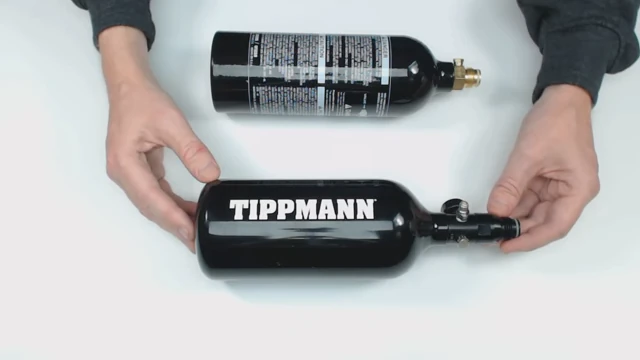
First, Know Your Tank: CO2 or HPA
Paintball markers run on one of two different air systems, and they’re filled completely differently:
- CO2 tanks hold liquid carbon dioxide and are measured by weight in ounces (9, 12, 20 oz). They’re filled with CO2 gas and weighed on a scale to the correct fill, not filled with plain air.
- HPA tanks (compressed air, sometimes called nitrogen/N2) are measured in PSI and volume (e.g. 48ci/3,000 PSI or 68ci/4,500 PSI). They’re filled with clean compressed air to the pressure stamped on the bottle.
Both are reusable and refillable, a CO2 tank is not single-use. Always check the tank type and rating before you fill.
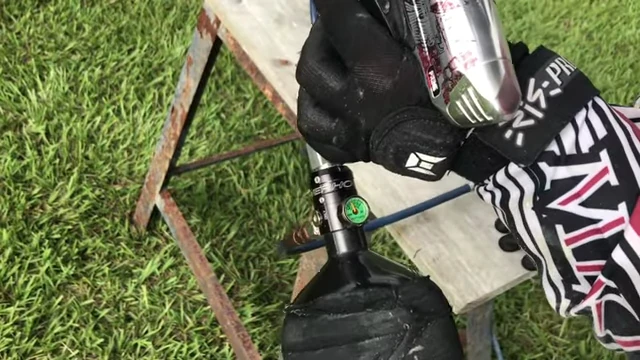
Where to Fill Each Type
CO2: paintball fields and pro shops, some sporting-goods stores, and welding-gas suppliers that carry bulk CO2. It’s filled from a bulk CO2 source and weighed on a scale, a standard workshop air compressor cannot fill a CO2 tank.
HPA: paintball fields, pro shops, and scuba/dive shops, whose compressors reach the 3,000–4,500 PSI these tanks need. An ordinary garage air compressor maxes out around 150 PSI, nowhere near enough, so it can’t fill an HPA tank either.
Filling at Home
To fill up at home you will need the right high-pressure setup. For HPA, that means a large scuba or “cascade” tank with a fill station, or a dedicated high-pressure (PCP) compressor rated to 4,500 PSI, not a normal air compressor. Connect the fill line, open the valve slowly to avoid heat build-up, watch the gauge, and stop at the rated pressure. For CO2, you need a bulk CO2 tank, a fill station with a bleed valve, and a scale; keep the tank upright, chill it if possible for a fuller fill, and weigh to the rated ounces. Bleed the line before disconnecting.
Safety First
- Never exceed the rated pressure or overfill a CO2 tank by weight.
- Check the hydrostatic test date, shops won’t fill an expired or damaged tank, and neither should you.
- Fill slowly and bleed the line before disconnecting.
- If a tank is expired or damaged, empty and retire it safely rather than filling it.
How Often Will You Need a Refill?
How frequently you refill depends on your tank size and how much you shoot. A smaller tank might need topping up once or twice across a busy day, while a larger HPA bottle can last a full session. Because fields have fill stations, many players simply top up between games rather than carrying spares, though a second, pre-filled tank is a convenient way to avoid queuing at the fill station during a fast-paced day.
Safety Checks Before Every Fill
Make a quick habit of inspecting the tank before filling. Check that the hydrostatic test date is current, look the bottle over for cracks, deep scratches, or damage to a carbon-fibre wrap, and confirm you’re filling to the correct rated pressure, never above it. Fill slowly to avoid heat build-up and a false reading, and if anything about the tank looks off, have it checked rather than pressurising it.
CO2 vs HPA: Which Is Easier to Fill?
If convenience matters, HPA is the easier system to live with. It fills quickly anywhere that has high-pressure air, fields, pro shops, and scuba shops, and its performance stays consistent whatever the weather. CO2 is cheaper to buy into but fussier: it needs an actual CO2 gas supply and a scale to fill by weight, and its velocity wanders with temperature. For a player who just wants to turn up, fill, and play without thinking about it, HPA is the more forgiving choice, which is a big reason it has become the standard.
Conclusion
Filling a paintball tank is easy when you match the method to the tank: CO2 gets weighed in from a CO2 supply, HPA gets high-pressure air from a scuba shop or PCP compressor. For most players, a field or pro shop is the quickest and safest option. Whatever you use, respect the rated pressure and hydro date, and never try to fill either tank with a standard air compressor.
FAQs
No. A standard workshop air compressor only reaches about 150 PSI, while HPA tanks need 3,000–4,500 PSI. CO2 tanks aren’t filled with air at all, they need a bulk CO2 supply. Use a field, pro shop, scuba shop, or a dedicated high-pressure compressor.
Yes, with the right gear. HPA tanks can be filled from a scuba/cascade tank and fill station or a high-pressure (PCP) compressor rated to 4,500 PSI; CO2 needs a bulk CO2 tank, a fill station, and a scale. Never use an ordinary air compressor.
At a field or pro shop, an air or CO2 fill is usually just a few dollars and is often included with a day pass. Filling at home costs more upfront for the equipment but is cheaper per fill over time.
Paintball fields, pro shops, and scuba/dive shops can all fill HPA tanks, since their compressors reach the required 3,000–4,500 PSI. Call ahead to confirm a dive shop fills paintball tanks and the pressure they offer.